
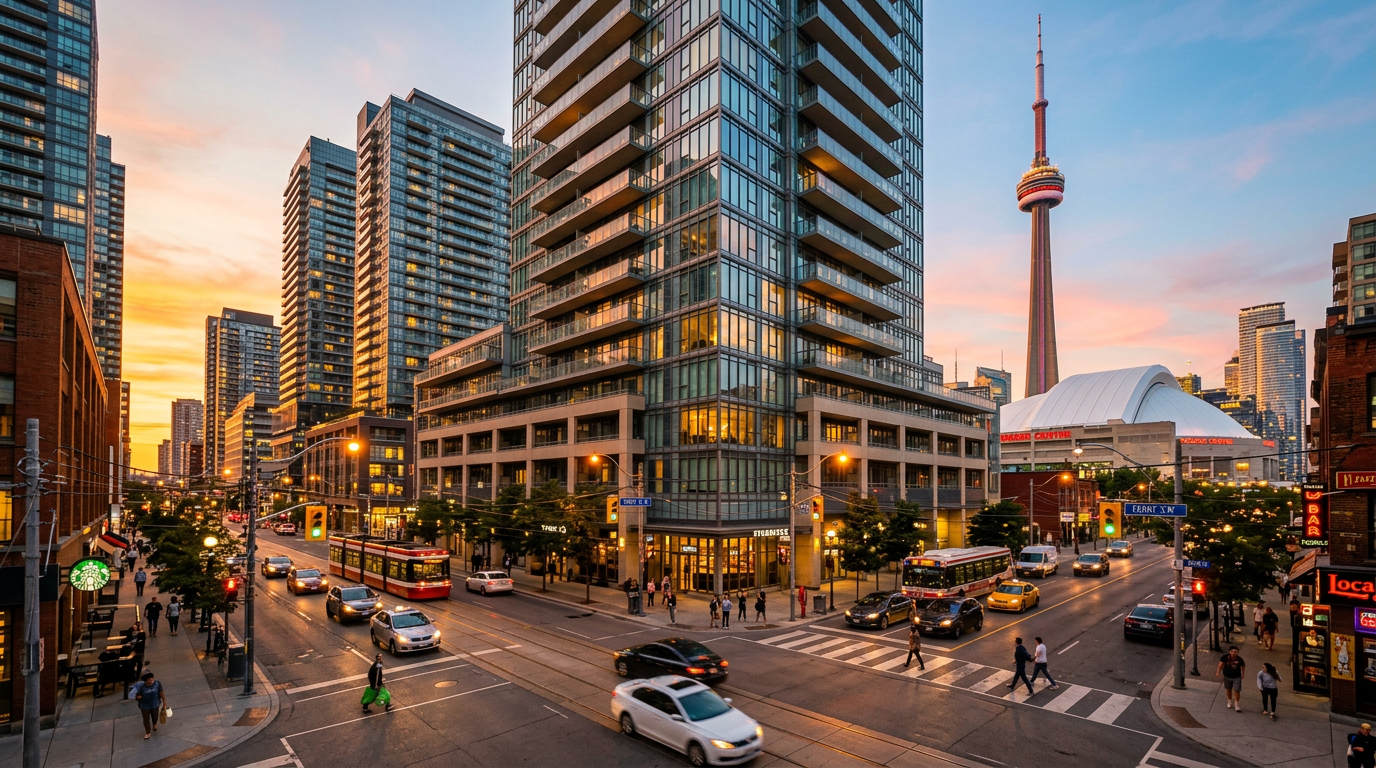
300 Front Street West is the building Toronto owners ask about most. It sits at Front and John, across from the Metro Toronto Convention Centre. The CN Tower, Rogers Centre and Union Station are a short walk away.
It also has more short-term rental registrations than almost any other condo in the city. That count is a strong signal. It is not permission for your unit.
This guide covers what the registration counts actually say, what the condo board position means, which City rules still apply, what revenue benchmarks are sourced and dated, who stays in this building, and what to do if short-term rental does not work for your unit.
Quick facts
- Building: 300 Front Street West (with its sister address, 20 John Street), Toronto
- Developer: Tridel. 49 storeys, about 683 suites. Condo corporation TSCC 2338, registered in 2013. Managed by Del Property Management.
- Registrations: 237 at this address in a March 2026 analysis of City of Toronto registration data. Later 2026 counts from other sources are higher and use different groupings. See the count section below.
- City rules: principal residence only, $390 a year to register, entire-unit rentals capped at 180 nights per calendar year, short-term rental means under 28 nights.
- Tax on a stay: 6% Municipal Accommodation Tax since August 1, 2026, plus 13% HST on the price including the MAT.
- Category: Market Insights
TL;DR
- 300 Front Street West has one of the highest short-term rental registration counts in Toronto. That is a signal the building has not blocked hosting. It is not a board ruling for your unit.
- Counts differ by source and date: 237 in March 2026, and higher combined counts later in 2026 when 20 John Street is included. Always check the current register and your status certificate.
- The City gate still applies in full: principal residence only, $390 a year, 180-night cap on entire-unit rentals, and 6% MAT.
- Use citywide benchmarks with care. AirROI put Toronto’s median nightly rate at $160 and average occupancy at 47% for the 12 months to October 2026. This building is not the city average, in either direction.
- If your unit is not your principal residence, the legal route is 28 nights or more. That is a mid-term rental, not a short-term rental.
Table of Contents
- Does 300 Front Street West allow Airbnb?
- What the registration counts say, and what they do not
- The building at a glance
- Gate two: the condo board and the status certificate
- Gate one: the City rules that apply here
- Who stays at 300 Front Street West
- Revenue benchmarks, sourced and dated
- A worked example at the city median
- The other side of a popular building: competition
- The mid-term fallback for investment units
- Before you list a unit in this building
- How Home Again helps owners in buildings like this
- Frequently asked questions
Does 300 Front Street West allow Airbnb?
Short answer: many owners in this building do host, and the registration record shows it. No city list, and no article, can clear your specific unit.
Toronto does not approve buildings. It registers people. One operator, one principal residence, one registration number. A building reaches a high registration count only when its condo corporation has not blocked hosting in a way that stops owners from registering. That is why the count matters.
But two gates must both pass. The City gate is registration and the principal residence rule. The condo gate is your declaration, bylaws and rules. If either gate fails, you cannot legally run stays under 28 nights in that unit. Our guide to Toronto condos that allow Airbnb explains how to read a building that is not on a list, and our can I Airbnb my condo in Toronto guide covers the permission check step by step.
What the registration counts say, and what they do not
Read every count with its source and date. The numbers below do not match each other, because they were taken at different times and grouped in different ways. That is normal for a live register. Registrations last one year. They are renewed, allowed to lapse, or revoked.
- March 2026: 237 registrations at 300 Front Street West. That was the highest count for a single condo address in an analysis of City of Toronto Short-Term Rental Registration Data covering 7,422 registrations in total, with 3,001 registrations in condos across 435 buildings. We reported this count in our October 2026 top-20 buildings guide.
- September 2026: a Move Smartly analysis of the City register counted 299 of the building’s 684 units registered, about 43.7%. That was the highest share on its list.
- November 2026: Park Place Properties, a manager active in the building, reported 259 licences at 300 Front Street West and 39 at 20 John Street, for 298 combined across the two addresses.
What a count proves: at that date, that many operators held a City registration at that address. What it does not prove: that the board has ruled in favour of hosting for all time, that your unit is eligible, or that those units are all actively taking bookings today.
Do not pick the highest number and treat it as the truth. Use the pattern. Across every dated count in 2026, this building sits at or near the top of the Toronto register. That pattern is the useful fact for an owner.
The building at a glance
300 Front Street West is a 49-storey Tridel tower at Front and John, with about 683 suites. The condo corporation is TSCC 2338, registered in 2013, and the building is managed by Del Property Management. The sister address, 20 John Street, is the lower loft building on the same site, which is why the two addresses are often counted together.
Published amenities include a rooftop pool and sun deck, a fitness centre and yoga studio, a theatre, a billiards room, party and lounge space, barbecues, guest suites and a 24-hour concierge. Check the current rules before you promise any amenity to guests. Condo boards can limit guest use of amenities such as the gym, pool and rooftop, even in a building where hosting itself is allowed. Never list an amenity your guests cannot actually use.
Unit sizes are mostly small downtown layouts. That matters for revenue. A one-bedroom here competes with hundreds of similar one-bedrooms in the same few blocks, not with a large house across the city.
Gate two: the condo board and the status certificate
A condo corporation can prohibit or restrict short-term rentals through its declaration or a rule passed by the board. The City does not check this for you. Its operator guidance says plainly that if you live in a condominium, you must make sure your condominium bylaws and rules allow short-term rentals.
For a buyer, the check is the status certificate. Under section 76 of the Condominium Act, a corporation must deliver a status certificate within 10 days, and the fee is capped at $100 including taxes. Read the declaration and rules that come with it. Look for a minimum lease term, a short-term rental ban, or a rule that limits rentals to owners.
For an owner who already holds the unit, ask the condo manager in writing and keep the reply. A verbal yes at the concierge desk is not a record. Our Toronto condo board rules guide sets out what boards can and cannot do, and what happens when a board changes its position after you have started hosting.
One more caution for this building in particular. A high registration count can draw board attention. Rules can change. A registration today is not a promise about next year, which is one reason the mid-term route below matters even for owners who can host now.
Gate one: the City rules that apply here
Every host in this building meets the same City rules as every other Toronto host, under Municipal Code Chapter 547.
- Short-term rental: all or part of a home rented for less than 28 consecutive nights.
- Principal residence only: you can only register the home you actually live in, the address on your bills, identification, taxes and insurance. One registration per dwelling unit.
- Registration: $390 a year for 2026. Your registration number goes on your listing. You choose entire-unit or partial-unit for the full term, and you can only switch at renewal.
- Night cap: entire-unit rentals are capped at 180 nights per calendar year. The count resets on January 1, not on your registration anniversary. Renting up to three bedrooms while you live in the home has no night cap.
- Tax: the Municipal Accommodation Tax is 6% since August 1, 2026, on stays under 28 nights. HST at 13% applies on the price including the MAT. If your worldwide taxable supplies pass $30,000 in a year, or in a single quarter, you must register for GST/HST. Our Airbnb HST registration guide covers that threshold.
- Records and inspection: keep your booking records for three years and produce them within 30 days if the City asks. The operator must attend a City inspection in person. A manager or co-host cannot attend in your place.
Our Toronto licensing guide, 180-night rule guide and key dates calendar cover each of these in full. Do not copy another host’s registration number, and do not list before your own registration is approved.
Who stays at 300 Front Street West
Location is the whole story here. The building sits across from the Metro Toronto Convention Centre. That brings conference and trade show guests on weekdays, when much of the downtown market is quiet.
Weekends run on a different engine. Rogers Centre games and stadium concerts, the CN Tower and Ripley’s Aquarium, the theatre block on King Street West, and Scotiabank Arena are all a short walk away. Union Station gives guests the UP Express to Pearson Airport, GO Transit and the subway.
Two demand sources are worth more than one. A building that only fills on weekends has a pricing problem for five nights a week. A building that only fills for conferences has a weekend problem. This address has both, which is a real part of why so many owners here host.
It is also why event pricing matters more here than in most buildings. Our Toronto event pricing calendar sets out the dates to price up, and the lesson from the World Cup summer: a blanket hike across a long stretch underperformed pricing that followed the actual event nights.
Revenue benchmarks, sourced and dated
There is no public, building-level revenue dataset for 300 Front Street West that we can verify. Anyone who gives you a precise building average should be able to show you the source, the date and the sample. Here is what is sourced, and whose figures they are.
Citywide benchmark. AirROI’s Toronto data for the 12 months to October 2026, across 10,945 listings, put the median nightly rate at $160, the average rate at $250, average occupancy at 47%, and average gross revenue at about $31,609 a year. The year ran from an August peak of about $5,760 a month to a February low of about $2,590. The average is pulled up by large and luxury units. A small one-bedroom should be judged against the median, not the average.
A manager’s building figures, labelled as theirs. Park Place Properties published a revenue analysis for 300 Front Street West and 20 John Street in November 2026, based on the properties it manages there. In its figures, a one-bedroom averaged $242.25 a night and netted about $4,595.97 a month, and a two-bedroom averaged $468.13 a night. Its net annual figures assume 85% occupancy and a hybrid year: short-term stays up to the 180-night cap, then furnished stays of 28 nights or more. Those are one manager’s numbers for its own units, not a building average, and 85% occupancy is well above the citywide 47% average. Treat them as an upper case to test, not a forecast.
What to do with two very different numbers. Plan on the city median. Let a manager who works the building show you comparable units, with the occupancy and the season behind the rate. If the plan only works at the top figure, the plan does not work.
For a unit-specific estimate, use our Toronto condo income estimate page, and read how much a Toronto condo can earn on Airbnb for the full city breakdown by percentile.
A worked example at the city median
This is arithmetic at the city median, not a building result. It shows the shape of a month for a one-bedroom run legally inside the cap.
- 14 nights at the $160 city median: $2,240.00
- Cleaning fees from 3 stays at $115: $345.00
- Airbnb host-only fee at 15.5% on $2,585: -$400.68
- Cleaning cost, 3 turnovers at $115: -$345.00
- Management at 15% of the $2,240 nightly revenue: -$336.00
- Registration, $390 spread over 12 months: -$32.50
- Supplies and restocking: -$50.00
- Left before ownership costs: $1,420.82
Ownership costs come out of that figure: mortgage, condo fees, property tax, insurance and repairs. So do the nights you cannot sell once the 180-night cap is used. A downtown unit that rates above the city median will do better than this example. One that rates below it, or sits empty on weekdays, will do worse. The point of the example is the deductions, which owners consistently underestimate: the host fee alone takes $400.68 out of a $2,585 month.
The $115 turnover figure is the Toronto core one-bedroom average we use across our guides, including linens, restocking and a photo report. See our Toronto cleaning fees guide for how that number is built.
The other side of a popular building: competition
A high registration count cuts both ways. It tells you hosting is possible here. It also tells you that a guest searching this area sees many near-identical units, often in the same building, on the same night.
That changes what earns. Price alone will not do it, because someone in the building will always go lower. What separates the units that fill is the cover photo, the review record, the response time, and pricing that moves with the convention and event calendar instead of sitting flat.
Reviews compound. A unit with a long review history and a Guest Favorite badge is hard for a new listing in the same building to displace. Our Guest Favorite guide and Airbnb photography cost guide cover the two levers that matter most in a crowded building. Professional photos for a Toronto condo typically run $250 to $400 plus HST, and one extra booking at the city median covers most of that cost.
Also mind the building itself. Hundreds of short-term guests a month means elevator waits, concierge checks and neighbours who notice noise. House rules that fit the building, a disclosed noise approach, and fast handling of any complaint protect your registration and your standing with the board. Our Toronto condo house rules guide is written for exactly this setting.
The mid-term fallback for investment units
If the unit is not your principal residence, you cannot register it for stays under 28 nights. That is not a grey area, and a manager cannot fix it for you. What you can do is rent it for 28 nights or more.
Stays of 28 nights or more sit outside the City’s short-term rental definition. They use no nights from the 180-night cap, and they carry no Municipal Accommodation Tax. Demand for furnished monthly stays in downtown Toronto comes from relocation, corporate work, insurance displacement after a fire or flood, and people between homes. Rentals.ca and Urbanation put Toronto’s average asking rent at $2,554 a month in September 2026, which is the comparison a furnished monthly rate has to beat after fees to be worth the extra work.
Two cautions. First, Ontario’s Residential Tenancies Act has no simple day-count safe harbour. Whether a long stay becomes a tenancy depends on the substance of the arrangement, not only its length. Take advice before you rely on a fixed number of nights. Second, a monthly discount on Airbnb is a pricing tool, not a legal category. Our monthly discount guide, mid-term rentals Toronto guide and hybrid strategy guide cover how owners combine both, legally, across a year.
For an owner who does live in the unit, the hybrid is often the best use of this building: short-term stays in the strong months, inside the cap, then a 28-night-or-more block in the winter instead of chasing low nightly rates.
Before you list a unit in this building
- Confirm the unit is your principal residence. If it is not, stop and use the mid-term route.
- Read your declaration and rules, or the status certificate if you are buying. Get the condo manager’s position in writing.
- Register with the City and wait for approval before you advertise. Put your own registration number on the listing.
- Choose entire-unit or partial-unit for the full registration term. You cannot switch mid-term.
- Plan the year around 180 nights. Decide in advance which months are short-term and which are mid-term.
- Set up the tax side: 6% MAT on short stays, 13% HST on the price including MAT, and the $30,000 GST/HST registration threshold.
- Budget the real deductions: 15.5% host-only fee, about $115 a turnover for a core one-bedroom, and management if you use it.
- Invest first in photos and the first five reviews. In this building, that is where new listings lose.
- Check which amenities guests may actually use, and list only those.
- Keep booking records for three years, and be ready to attend a City inspection yourself.
If you are still deciding whether to buy in a building like this one, read buying a property for Airbnb in Toronto first. The principal residence rule is the trap most buyers find last.
How Home Again helps owners in buildings like this
Home Again manages Toronto condos for owners, including downtown buildings with heavy short-term rental activity. Our full management fee is 15% of booking revenue, with no setup fee. We handle pricing, guest messaging, cleaning coordination, restocking and the record-keeping a Toronto registration requires.
What we will not do is list a unit that cannot be legally registered. If your unit is not your principal residence, we will tell you that on the first call and talk through the 28-night-or-more route instead. That honesty is worth more than a season of bookings followed by a revoked registration.
See our Toronto Airbnb management page for what full management covers, our management fees guide for how fees compare across the city, and our guide to choosing a management company if you are comparing managers for a downtown unit.
Frequently asked questions
Does 300 Front Street West allow Airbnb?
Many owners in the building host, and the City register shows one of the highest registration counts in Toronto at this address. That is a strong signal the building has not blocked hosting. It is not permission for your unit. You still need your own City registration, the unit must be your principal residence, and your condo declaration and rules must allow it. Check the status certificate and ask the condo manager in writing.
How many Airbnbs are at 300 Front Street West?
It depends on the date and how the addresses are grouped. A March 2026 analysis of City of Toronto registration data counted 237 registrations at 300 Front Street West. A September 2026 analysis counted 299 of 684 units registered. In November 2026, a manager active in the building reported 259 licences at 300 Front Street West plus 39 at the sister address, 20 John Street. Registrations change as they are renewed, lapse or are revoked, so check the current register.
Can I Airbnb a unit at 300 Front Street West if I do not live there?
Not for stays under 28 nights. Toronto only allows short-term rentals in your principal residence. A unit you do not live in cannot be registered. You can rent it for 28 nights or more as a mid-term rental, which sits outside the short-term rental rules, uses no nights from the 180-night cap and carries no Municipal Accommodation Tax.
How much can a unit at 300 Front Street West earn on Airbnb?
There is no verified public building average. AirROI put Toronto’s median nightly rate at $160 and average occupancy at 47% for the 12 months to October 2026. A manager active in the building published higher figures for its own units in November 2026, including a one-bedroom average of $242.25 a night, based on 85% occupancy and a hybrid year. Plan on the city median, and ask any manager for comparable units with the occupancy and season behind the rate.
What does it cost to register and run a unit here?
City registration is $390 a year for 2026. On each booking, Airbnb’s host-only fee is 15.5% of the subtotal, a core one-bedroom turnover clean runs about $115, and full management is typically a percentage of booking revenue. Home Again charges 15% of booking revenue with no setup fee. Short stays also carry 6% Municipal Accommodation Tax and 13% HST on the price including the tax, which are guest-side charges you must handle correctly.
Is 300 Front Street West a good building to buy for Airbnb?
Only if you will live there. The principal residence rule means a pure investment purchase cannot legally run stays under 28 nights, in this building or any other Toronto building. If you plan to live in the unit and host while you are away, the location and the registration record are strong. If you are buying as an investment, price the unit on 28-night-or-more furnished rentals and long-term rent, not on nightly rates.