
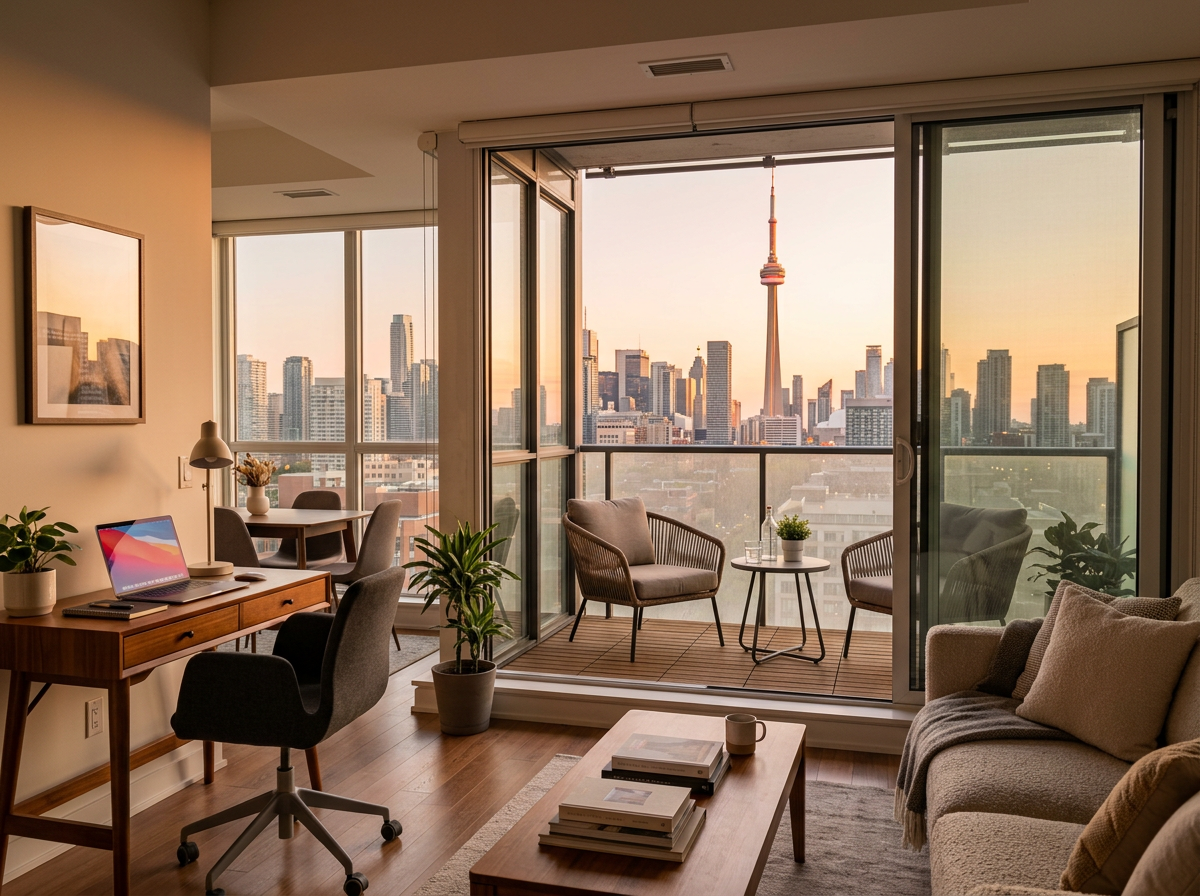
Every amenity list on the internet tells Toronto condo owners to add a hot tub. Almost none of them show what an amenity actually does to revenue — and a condo owner cannot add a hot tub anyway. The useful evidence is newer and more specific. In a study of 3,168 whole-home listings published in November 2026, a furnished outdoor living area was linked to about 19% more revenue than similar homes without one — the clearest result in the data. For a Toronto condo, the outdoor living area is the balcony. This guide works through the amenity evidence in order: what the studies actually measured, which amenities decide whether guests see your listing at all, which ones pay in a condo specifically, and where the big house-sized premiums do and do not apply to you.
TL;DR
- The clearest revenue result is outdoor living, not luxury. In Surge’s study of 3,168 whole-home listings (trailing 12 months to October 2026), homes with a furnished outdoor area earned about 19% more revenue than similar homes without one. A furnished Toronto balcony is the condo version of that amenity.
- Missing basics cost more than upgrades earn. In the same study, the few homes without a kitchen earned about 17% less, and homes without a washer earned about 18% less. Guests also filter by amenities, so a missing tick can remove your listing from a search entirely.
- Parking is the condo premium guests search for. Free parking is the second most-searched amenity worldwide in Airbnb’s own data. A downtown Toronto parking spot is worth roughly $150 to $400 a month on the rental market — if you own one, including it costs you nothing and opens that filter.
- A building pool is not a private pool. Large GTA houses with a private pool earned 96% more in one local study. Shared condo pools showed the opposite pattern in the broader data — small listings with a pool earned about 13% less. Price the building pool as a nice extra, never as the headline.
- Pet-friendly pays for houses and can backfire in small condos. Five-bedroom GTA homes that allow pets earned 34% more in the local study, but the same firm’s Toronto two-bedroom analysis found pets linked to 28% less revenue. Know your unit size before you copy a house result.
- Spend small, in the right order. Basics first, then the cheap filter-openers — a real workspace, a furnished balcony, self check-in, tested Wi-Fi with the speed shown. Judge every change on revenue over 60 to 90 days, not on the nightly rate alone.
On this page:
- What the Revenue Data Actually Says
- The Filter Effect: Amenities Decide Who Sees You
- The Basics That Cost You When They Are Missing
- Parking: The Clearest Condo Premium
- A Real Workspace and Tested Wi-Fi
- Building Amenities: The Gym Helps, the Pool Needs Care
- The Balcony: A Condo’s Outdoor Living Room
- Self Check-In and the Small Conversion Amenities
- Pet-Friendly: Great for Houses, Risky for Small Condos
- Where the Big Premiums Live: Houses and Large GTA Homes
- What Does Not Pay — or Cannot Be Measured
- Worked Example: A $900 Amenity Package on a Toronto One-Bedroom
- How Home Again Helps Toronto Owners
- Frequently Asked Questions
What the Revenue Data Actually Says
Three datasets do the real work in this guide. Each is labelled wherever it is used, because they measured different homes in different places:
- Surge (published November 1, 2026). A study of 3,168 entire-home Airbnb listings from one large U.S. market, trailing 12 months to October 2026. Each listing was active at least 180 days with at least 3 reviews. Revenue, nightly rate, and occupancy were compared across similar homes — controlling for location, bedrooms, bathrooms, guest count, rating, review count, and days available — with every amenity measured at the same time. It is the cleanest amenity-by-amenity comparison available, and its limits matter: one U.S. market, whole homes, and an association study, not an experiment.
- Nurture Stays (January 2026 analysis). A study of 296 five-bedroom listings in Scarborough, Pickering, and Ajax with enough revenue data, drawn from 342 active listings. This is the local GTA evidence — and it describes large group houses, not downtown condos. Its own Toronto two-bedroom comparison, cited on the same page, sometimes points the other way. Both directions are reported here.
- BNBCalc and AirDNA (October 2026 and January 2026). BNBCalc’s October 2026 amenity run covers 454 U.S. markets and reports the median revenue lift per amenity across markets. AirDNA’s national analysis reports nightly-rate lifts. Both are U.S.-wide cross-checks on the same few amenities.
Three cautions apply to every number that follows. First, these are associations: owners who furnish a balcony well may also price, photograph, and manage well, and no study can fully separate that. Treat each figure as a direction and a rough size, not a promise for your condo. Second, nightly rate and revenue are different scoreboards — a pool raised the nightly rate about 16% in the Surge data while annual revenue came out flat, because those homes booked fewer nights. Third, Toronto’s own market frame is AirROI’s latest report (12 months to October 2026): about 10,945 active listings, average gross bookings of $31,609 per listing for the year, a $250 average nightly rate, a $160 median nightly rate, and 47% occupancy. Amenity choices are one of the few levers that move a single listing inside that frame. For the full picture, see how much a Toronto condo earns on Airbnb.
The Filter Effect: Amenities Decide Who Sees You
Before an amenity can raise your rate, it decides whether a guest sees your listing at all. Guests filter search results by amenity. A listing without the ticked box does not appear in that filtered search — at any price, with any photos.
Airbnb’s own guide (published August 31, 2026, from its internal data on the amenities guests searched for most often worldwide in 2025) gives the top ten, in order:
- Pool
- Free parking
- Wi-Fi
- Air conditioning or heating
- Kitchen
- Hot tub
- Washer or dryer
- Self check-in
- TV or cable
- BBQ grill
Read that list as a Toronto condo owner. You cannot add a private pool or a hot tub, and most buildings settle the BBQ question for you. The other seven are all within your control: parking if you own a spot, Wi-Fi, heating and air conditioning that actually work, a real kitchen, in-suite laundry, self check-in, and a TV guests can sign into. Every one you honestly have and do not list is a filtered search you are invisible in. The first amenity job on any listing is an audit: walk the unit room by room against Airbnb’s amenity list, tick everything that is truly there, and photograph the items guests filter for. Our Toronto host checklist includes that audit in the listing setup steps.
Accuracy is the other half. Only list what a guest can actually use — a building amenity your condo board bars short-term guests from using is not an amenity, it is a complaint waiting to happen. Accuracy is also one of the six categories guests score, and those scores feed the Guest Favorite badge covered in our Guest Favorite guide.
The Basics That Cost You When They Are Missing
The strongest negative numbers in the Surge study are not about luxuries. They are about basics:
- No kitchen: about 17% less revenue than similar homes with one. The group without a kitchen was small, so the exact figure carries a wide range — but the direction is plain, and kitchen is the fifth most-searched amenity on Airbnb’s list. For a condo, “kitchen” means a kitchen a guest can cook in: working burners and oven, sharp knives, pots and pans, a coffee maker with filters and coffee, oil, salt and pepper, dish soap and a sponge. A microwave and a kettle do not pass that test on a week-long stay.
- No washer: about 18% less revenue. Again a small comparison group, and again the direction matches the search data — washer or dryer is seventh on Airbnb’s most-searched list. In-suite laundry is the version that counts most for condos: it is what makes a 7-night or 28-night stay practical, and winter and mid-term guests ask about it by name. If your unit has laundry in the building rather than in the suite, say exactly where it is, what it costs, and how payment works. If it has neither, you are priced for short stays only — set the listing up honestly for that guest instead of hoping nobody notices.
- Wi-Fi is the floor, not a feature. In the Surge sample, 99.5% of homes list Wi-Fi. Having it earns nothing extra. Not having it, or having slow Wi-Fi that fails on a video call, costs reviews — and communication and accuracy scores are Guest Favorite categories. The workspace section below covers the tested-speed fix.
- Heating and air conditioning. Fourth on Airbnb’s most-searched list, and in Toronto it is a two-season test: a condo that overheats in July and a condo a guest cannot warm in January both collect the same review. Check the fan-coil or heat pump before the season turns, and leave simple instructions in the unit.
- A TV guests can use. Homes with a TV earned about 9% more than similar homes without one in the Surge data. The modern version is a smart TV guests can sign into with their own accounts — and a note in the house manual reminding them to sign out, with your own check at turnover.
None of this is glamorous, and that is the point. The basics are the price of entry: they decide which searches you appear in and whether a longer stay is even possible. Spend here first. Our guide to furnishing a Toronto condo for Airbnb costs the full setup room by room.
Parking: The Clearest Condo Premium
Free parking is the second most-searched amenity in Airbnb’s worldwide data — ahead of Wi-Fi. In downtown Toronto it is also genuinely scarce, which is what makes it valuable.
The value is easy to show a guest. Market listings for monthly Toronto condo parking typically run about $150 to $400 or more a month (WhereiPark’s summary of active listings: roughly $150 to $250 in suburban and midtown areas, $300 to $400 or more for prime downtown and EV-equipped spots). A guest driving in for a weekend faces downtown garage rates instead — at the garages near 14 York Street, a weekday 24 hours runs about $39 and a full day about $40. Two or three days of garage parking can cost a guest more than $100. A condo that includes a spot is not offering a small perk. It is removing a real line item from the trip.
Three rules make parking pay instead of causing trouble:
- Only promise a spot you control. An owned or exclusively assigned spot you can legally let a guest use is an amenity. Visitor parking is not — many buildings limit visitor permits to a few nights, require permits in advance, or bar short-term guests from visitor parking entirely. Check your building’s rules before the word “parking” appears anywhere in the listing. Our condo board rules guide covers where parking restrictions usually sit in the documents.
- Say exactly what it is. Underground or surface, the stall number, how the fob or pass hand-off works with your self check-in, height limits, and whether EV charging exists and what it costs. “Free parking” with no detail earns questions; a precise description earns the booking.
- Put it early. Parking belongs in the first photos and the opening lines if your guests drive — for many Toronto condos that means weekend and family guests from elsewhere in Ontario, not downtown locals. Match the emphasis to the guest who books you.
One honest limit: no Toronto-specific study isolates a parking revenue premium for condos, and the Surge study’s homes almost all had parking, so it could not price the difference either. The case for parking rests on the search rank (number two worldwide), the visible guest saving, and the filter effect — not on a claimed percentage. If you own a spot and are not listing it, that is the cheapest fix in this entire guide.
A Real Workspace and Tested Wi-Fi
A dedicated workspace rarely tops a most-searched list. Its value is different: it changes which guest books you, and that guest stays longer and books weekdays.
Airbnb’s own remote-work guidance lists what those guests look for: fast and reliable Wi-Fi, a dedicated workspace, ergonomic support such as a laptop stand, good lighting, and office supplies including pens, paper, and a universal charger. That is a shopping list that fits in a condo den or a corner of a living room:
- A real desk and a real chair. A desk or table used for work, a chair a person can sit in for a full day, and a power outlet within reach. A dining chair at the kitchen counter is the version guests punish in reviews — the workspace tick is self-reported, so guests arrive expecting what the photos show. Photograph the workspace set up, with a laptop on it, so the claim is checkable at a glance.
- Tested Wi-Fi, with the number shown. Hosts can run Airbnb’s in-app speed test at the unit, and the listing can display the result — Airbnb displays speeds of 50 Mbps or more as “Fast wifi.” A displayed number does two jobs: it passes the remote worker’s own check, and it supports the longer stays that fill winter. Run the test at the desk, not beside the router, and re-run it if you change providers.
- The small kit. A laptop stand, a desk lamp, a power bar, a universal charger, pens and paper. Together these cost less than one night’s rate at Toronto’s $160 median, and they are the difference between a workspace claim and a workspace.
Why it matters in Toronto specifically: the guests a workspace attracts — contract and project workers, hospital and university visitors, relocation stays — are the same guests who book the 7-night to 28-night stays that carry a condo through the slow months. Our winter slow season guide shows January and February stays averaging about 10 nights. A workspace does not need its own published premium to earn its cost back. It needs to win a few of those longer stays a year — and to be visible in the listing when that guest is choosing.
Building Amenities: The Gym Helps, the Pool Needs Care
Condo owners do not choose their building’s amenities, but they choose how to price and present them. The data splits the two headliners sharply:
- Gym or fitness area. In the Surge study, homes with a gym or fitness area booked about 3 more points of occupancy, with revenue about 9% higher — a result the authors flag as not statistically certain overall. In the 1- and 2-bedroom segment, the homes a business traveller books, gym access was linked to about 19% more revenue, close to but not quite certain. BNBCalc’s U.S. markets put the gym’s median lift much lower, at 4%. Read together: a building gym is a real plus for the weekday and longer-stay guest, worth featuring — not a reason to raise the rate on its own.
- Shared pool. Here the condo story reverses the house story. In the Surge data, pool homes charged about 16% more per night but booked about 3.6 fewer points of occupancy, leaving annual revenue flat — and in 1- and 2-bedroom listings, homes with a pool earned about 13% less than similar homes without one. The study’s own explanation fits condos exactly: many small listings with a “pool” have a shared community pool, which guests treat as standard rather than special, while the host prices it as a feature. A building pool photographed honestly and priced as a bonus is fine. A building pool used to justify a rate above your comparable set costs bookings.
The gate that comes before either: does your building allow short-term guests to use the amenities at all? Even Airbnb-friendly Toronto buildings commonly restrict guest use of the gym, pool, rooftop, and party room, or require guest registration at security first. “Do not promise amenities in the listing unless the building allows short-term guests to use them” is the standing rule — it comes from the building documents, not from optimism. Check yours, list only what guests may use, and state any registration step in the check-in instructions. Buildings that permit rentals but restrict amenities are listed in our guide to Toronto condos that allow Airbnb — permission to rent and permission to use the pool are two separate questions.
The Balcony: A Condo’s Outdoor Living Room
The strongest single result in the Surge study belongs to an amenity most condo owners already have and underuse. Homes with a furnished outdoor living area earned about 19% more revenue than similar homes without one — a higher nightly rate (about 6% more) and more booked nights (about 1.9 points of occupancy) at the same time. When the researchers added photo quality and interior design scores for the homes they had scored, the result held at about 13%. It is an association, from whole homes in one U.S. market — but it is the clearest signal in the data, and the mechanism is visible: an outdoor area gives guests a place to spend the evening, and it photographs as a lifestyle, not a room.
The condo translation is direct:
- Furnish it like a room. Two chairs that are comfortable to sit in, a small table, an outdoor rug, and lighting that works after dark. A bare balcony with one folding chair is the “two chairs” version the study’s method notes warn about — the tick is present, the amenity is not.
- Respect the building’s balcony rules. Many Toronto condo rules limit balcony furniture, storage, and anything visible from outside, and some restrict BBQs on balconies outright — which is why the BBQ on Airbnb’s most-searched list is usually a building amenity question, not a purchase. Work inside your building’s rules and say where the building’s BBQ terrace is, if guests may use it.
- Photograph it at the right hour. The balcony shot is a cover-photo candidate in summer and a top-five photo all year. Our Toronto Airbnb photography guide covers shot order and the cover choice.
- Season it honestly. A furnished balcony sells May to October. In winter it still shows space and light in photos, but the listing copy should sell the warm interior instead — do not headline an amenity the guest cannot use in January.
Cost is the other half of the case. A proper small balcony set is a few hundred dollars — a fraction of a hot tub, with no water testing, no chemicals, and no cleaner protocol added to every turnover. Of every upgrade in this guide, it is the one where the evidence, the cost, and condo reality point the same way.
Self Check-In and the Small Conversion Amenities
Some amenities do not open a premium. They remove a reason not to book. Self check-in is eighth on Airbnb’s most-searched list, and it is the standard example:
- Self check-in with a smart lock. A unique code per stay lets guests arrive at any hour, removes the key hand-off, and improves security over a shared code. In Toronto condos it has to work with the building’s own access — fob rules, lockbox rules, and concierge procedures vary by building and are covered in our Toronto self check-in guide. A smart lock is a one-time cost in the low hundreds of dollars installed. No study here isolates a self check-in revenue premium, and this guide will not invent one: its value is conversion and operations — fewer failed arrivals, fewer late-night lockouts, better check-in scores.
- Blackout curtains and real bedding. Downtown light and noise are the two sleep complaints a host can actually fix. Blackout curtains in the bedroom, extra pillows, and a spare blanket cost little and defend the cleanliness-and-comfort scores that reviews are built on.
- A stocked arrival. Coffee and tea, basic cooking staples, enough toilet paper and supplies for the stay length booked — the essentials Airbnb lists as expected on every stay. Shorting a 10-night guest on supplies to save $10 is the worst trade in hosting.
- Family basics, if families book you. A travel crib, a high chair, and outlet covers open the family filter cheaply for larger units. For a one-bedroom aimed at couples and workers, skip them and spend the money on the workspace instead. Match the kit to the guest who actually books — that matching, not the size of the kit, is what the data rewards.
Pet-Friendly: Great for Houses, Risky for Small Condos
No amenity in this guide splits by property type as sharply as pets. All three figures below are real, sourced, and labelled — and they do not agree, because they measured different homes:
- Whole homes, Surge (U.S.): pet-friendly homes earned about 7% more revenue, and the lift came from occupancy — about 3.4 more points — even though they charged about 5% less per night. Allowing pets widened the pool of guests who could book.
- Five-bedroom GTA houses, Nurture: listings that allow pets earned 34% more — $3,256 a month against $2,424. Large groups travelling with dogs have few options, and a big house absorbs the wear.
- Toronto two-bedrooms, Nurture’s own comparison: pets were linked to 28% less revenue. Their explanation: smaller units attract solo travellers and couples, who rarely travel with pets — so the policy adds cleaning cost and wear without adding the guest.
For a Toronto condo, add two local facts to that split. First, your condo documents may set the pet rules for you — many buildings restrict pet size, number, or pets in rented units at all, and a short-term guest’s pet is still a pet under those rules. Second, the operating cost lands per turnover: extra cleaning time, lint and allergen management for the next guest, and the risk to the cleaning standard the next review is scored on, against a core one-bedroom turnover that already costs about $115.
The honest verdict: for houses and large units, pet-friendly is one of the better-supported revenue moves in this guide — set a pet fee, clear rules (number, size, never on furniture), and the kit (bowls, pet towels, waste bags, washable covers). For a small downtown condo, the only Toronto-specific data point available says the policy likely costs more than it earns. Default to no, unless your own booking history shows guests asking — and your building allows it.
Where the Big Premiums Live: Houses and Large GTA Homes
The headline numbers that sell amenity articles — the ones behind the hot tub advice this guide opened with — are real. They just belong to a different property type. From Nurture’s January 2026 analysis of 296 five-bedroom listings in Scarborough, Pickering, and Ajax:
- Private pool: 96% more revenue — $4,972 a month against $2,540 without. Only 17 of the 296 listings had a pool. Groups book pool houses on purpose and pay for them.
- Hot tub: 65% more revenue — $4,284 a month against $2,600. A hot tub also works in winter, when a Toronto-area pool does not.
- Guest Favorite badge: 81% more — $3,782 a month against $2,092. Not an amenity you can buy, but the trust signal groups booking an expensive house rely on.
- Bathrooms: 4.5 or more earned 58% more than 1 to 2 bathrooms ($3,339 against $2,119) — for groups of 10 to 14, bathroom access is a booking condition, not a luxury.
The cross-checks agree on direction for houses. AirDNA’s national analysis puts hot tubs at about 14.3% more per night. BNBCalc’s October 2026 run finds a hot tub lift in 433 of 454 U.S. markets, at a median of 19% — and its pool lift grows with house size, from a median 4% for two-bedrooms to 14% for four bedrooms or more. Surge, the most cautious of the three, still found hot tubs raising the nightly rate about 16% with no loss of occupancy.
If you own a GTA house, this section is your shopping list, in that order — and the operating warning travels with it: a hot tub earns only if the water is tested and logged at every turnover, because a cloudy tub shows up in reviews faster than the premium shows up in payouts. If you own a downtown condo, read these numbers as a boundary marker. They explain why competitors’ houses out-earn condos in the summer group market — and why copying their amenity list, instead of the condo list in the sections above, wastes money.
What Does Not Pay — or Cannot Be Measured
An honest amenity guide also lists the spending the data does not support:
- EV charging: no clear effect where it was measured directly. In the Surge study, EV chargers showed no measurable revenue, rate, or occupancy effect — only 4% of homes had one. BNBCalc’s U.S. markets disagree, putting the EV charger median lift at 9%. The fair reading: an EV charger may help in drive-to markets and larger homes; there is no condo-specific evidence it pays, and most Toronto condo owners cannot install one without condo board approval and a dedicated spot anyway. If your spot already has charging, list it. Do not build the case for buying on it.
- “Suitable for events”: 17% less revenue in the Surge data. The authors do not claim events themselves lose money — the tag likely draws one-night, high-wear bookings and neighbour complaints. In a Toronto condo, most buildings prohibit events and parties in any case. Leave the tag off.
- Game rooms, theatres, and sport courts: too rare to measure. Fewer than 3% of the Surge sample even mentioned a game room. Any precise premium for them would be noise. A board game shelf and a good TV cost almost nothing and fit the same “something to do together” pattern as the amenities that did pay — buy them as hospitality, not as a revenue claim.
- A higher rate that loses nights. The pool result is the standing warning: about 16% more per night, about 3.6 fewer points of occupancy, flat revenue. Judge every amenity change on booked revenue over 60 to 90 days — Surge’s own advice — with occupancy watched alongside the rate. Our dynamic pricing guide covers how to hold the rate discipline after an upgrade instead of pricing the upgrade twice.
Worked Example: A $900 Amenity Package on a Toronto One-Bedroom
Take a downtown one-bedroom at Toronto’s $160 median nightly rate (AirROI, 12 months to October 2026), in a typical month before any amenity work. Labelled arithmetic on the same unit — not a promise for any listing:
Before. The unit books 12 nights in 4 stays:
- Nightly revenue: 12 nights × $160 = $1,920. Cleaning fees from guests: 4 stays × $115 = $460. Booking subtotal: $2,380.
- Less Airbnb’s 15.5% host-only fee: −$368.90. Less cleaning costs: −$460. Less the month’s share of registration: −$32.50. Less supplies: −$50.
- Left before management and ownership costs: $1,468.60.
The package. A proper desk and ergonomic chair, lamp, laptop stand, and charger kit: about $550. A furnished balcony set — two chairs, a table, a rug, lighting: about $350. Total one-time spend: about $900, plus an afternoon re-doing the amenity audit and photos. The parking spot was already owned; listing it properly cost nothing.
After — a stated assumption, tested over the next 90 days. The listing now passes the workspace and parking filters and shows a furnished balcony in its top photos. The owner tests $170 a night and books 14 nights in 4 stays — two extra nights, at a $10 higher rate. Those two figures are an assumption for this example, not a study result; the studies above support the direction, not the exact size:
- Nightly revenue: 14 nights × $170 = $2,380. Cleaning fees: 4 stays × $115 = $460. Booking subtotal: $2,840.
- Less Airbnb’s 15.5% host-only fee: −$440.20. Less cleaning costs: −$460. Less registration share: −$32.50. Less supplies: −$50.
- Left before management and ownership costs: $1,857.30 — $388.70 more for the month.
At that pace the $900 package pays back in about two and a half months. At Home Again’s 15% management fee on booking revenue, take a further $288 off the “before” month and $357 off the “after” month — the package still pays back in under three months. If the 90-day test shows only half the assumed gain, payback stretches to about five months, and the owner still owns a better listing. If it shows nothing, the loss is $900 and a lesson measured properly — which is why the test, and the order of spending, matter more than any single item. Not sure where your condo stands? Our Toronto condo income estimate shows what a unit like yours earns now, which is the baseline every amenity decision should be measured against.
How Home Again Helps Toronto Owners
Home Again manages Toronto and Mississauga condos for a 15% fee on booking revenue. That fee is charged on the booking revenue from each reservation, and it covers the amenity work in this guide: the room-by-room amenity audit against the filters guests actually use, checking the building’s guest and amenity rules before anything is promised in a listing, sequencing owner-approved upgrades basics-first, re-photographing and re-pricing after a change, and judging the result on 60 to 90 days of booked revenue — not on the nightly rate alone. Owners approve the spend. We run the test.
Start with a free income estimate for your condo to see the baseline, or see how full management works on our Toronto Airbnb management page. The fees behind that comparison are set out in our Toronto management fees guide.
Frequently Asked Questions
Which Airbnb amenities increase revenue the most?
In the clearest available study — 3,168 whole-home listings, trailing 12 months to October 2026 — a furnished outdoor area was linked to about 19% more revenue, the strongest result. Hot tubs raised the nightly rate about 16% with no loss of occupancy. For Toronto condos, the amenities that matter most are the ones you can actually control: free parking if you own a spot, a real workspace with tested fast Wi-Fi, in-suite laundry, a furnished balcony, and self check-in.
Does a pool increase Airbnb revenue for a Toronto condo?
Not on the available evidence. The large local premium — 96% more revenue — belongs to private pools on five-bedroom GTA houses. In the broader whole-home data, 1- and 2-bedroom listings with a pool earned about 13% less than similar listings without one, because a shared building pool is treated by guests as standard while hosts price it as special. Feature your building pool honestly, and first check that your condo board allows short-term guests to use it.
Is free parking worth offering in downtown Toronto?
Yes, if you own or control the spot. Free parking is the second most-searched amenity in Airbnb’s worldwide guest data, monthly Toronto condo parking typically runs about $150 to $400 or more, and a guest’s downtown garage alternative can cost about $40 a day. Including a spot you already own costs nothing, opens that search filter, and removes a real cost from the guest’s trip. Never promise visitor or building parking your guests are not allowed to use.
Should a Toronto condo allow pets?
Usually not for a small unit. Pet-friendly five-bedroom GTA houses earned 34% more in the local study, and whole homes overall earned about 7% more, mostly from extra booked nights. But the same local firm’s Toronto two-bedroom analysis found pets linked to 28% less revenue — small units draw guests who rarely travel with pets, while the owner still pays the extra cleaning and wear. Your condo documents may also restrict pets in rented units. Check both before deciding.
How much should I spend on Airbnb amenities?
Basics first — a working kitchen, laundry access, reliable Wi-Fi, and heating and cooling — because missing them is what the data punishes most. Then the cheap filter-openers: in this guide’s worked example, a workspace and balcony package of about $900 paid back in under three months on stated, tested assumptions. Whatever you spend, judge it on booked revenue over 60 to 90 days, with occupancy watched alongside the nightly rate.
Can I list building amenities like the gym and pool in my Airbnb listing?
Only if your condo board allows short-term guests to use them. Even buildings that permit short-term rentals commonly restrict guest use of the gym, pool, rooftop, and party room, or require guest registration first. Listing an amenity guests cannot use breaks Airbnb’s accuracy expectations and produces the complaints and low accuracy scores that cost far more than the amenity was worth. Check the building documents, then list exactly what guests may use.